The Martyr
On February 14, Quentin Deranque died after being severely beaten by far-left activists. Behind lies a larger story about French extremism.

Rima Hassan, French Member of the European Parliament, was born stateless in a refugee camp in Syria, has Palestinian background, and represents the radical left party La France Insoumise (LFI). She is a controversial politician.
On several occasions she has described aspects of Hamas’ activities as legitimate, even though she has also accused the group of war crimes in connection with the terrorist attack on Israel on October 7, 2023. Controversy also arose from her attendning a Gaza demonstration during a visit to the Jordanian capital Amman in August 2024. In that context, the right-wing newspaper Le Point wrote that she appeared as “pro-Hamas”, “without reservation”. They referred, among other things, to the fact that other demonstrators held up placards praising the late Hamas leader Ismail Haniyeh.
Hassan herself described Le Point´s story as fake news. “Using images of a few demonstrators who showed support for Hamas and attributing that to me is deeply dishonest,” she wrote on X.
On February 12, 2026, Rima Hassan delivered a lecture at the Institut d’Études Politiques de Lyon, also known as Sciences Po Lyon. About half an hour before the lecture, a small group of activists from the Identitarian women’s group Collectif Némesis appeared nearby. They unfurled a banner: “Islamos-gauchistes hors de nos facs” (“Islamo-leftists out of our universities”).
They also shouted: “We don’t want you, Rima!”
From across the street came a reply from other demonstrators: “Siamo tutti antifascisti,” Italian for “We are all antifascists.”
About ten minutes later, a fight broke out between far-right and far-left activists at the intersection of Boulevard Yves-Farge and Rue Victor Lagrange, a stone’s throw from the campus, on the other side of the railway tracks. Three far-right activists — young men who had shown up to support Collectif Némesis — were reportedly isolated from the others. Two of them managed to escape. The third did not.
Quentin Deranque, 23, was severely beaten. In a video recorded by a witness, he can also be seen lying on the ground, apparently unconscious, while kicks were directed at his head.
The masked assailants then left the scene, while a friend of Deranque tried to help him home. They did not make it. On the way his condition worsened, emergency services were called, and the young man was rushed to hospital. Two days later, on Saturday February 14, he died as a result of traumatic brain injury.
The death naturally provoked reactions. On February 15, Interior Minister Laurent Nuñez was asked whether the police could be blamed for failing to ensure security. He warned against “shifting the problem” and instead pointed directly at far-left activists. He also mentioned a specific far-left group that had already been forcibly dissolved by French authorities in the summer of 2025: Jeune Garde antifasciste (Antifascist Young Guard).
Nuñez said witness testimony clearly pointed in their direction.
At the same time, rumours began circulating online — largely spread by far-right influencers — linking named individuals to the attack. Among those accused was a woman who does indeed have a past in Jeune Garde, but who was reportedly abroad when Quentin Deranque was beaten.
Alleged photos of Deranque also began circulating, although in reality they were photos of entirely different men. One was a regional youth leader in the far-right party Rassemblement National. Another was a young father who died in a car accident in Belgium in 2024 and who had little in common with Deranque other than his first name.
In the days that followed, a number of far-left activists were arrested, suspected of involvement. Most of them are associated with Jeune Garde. Among them were two staff members of the LFI parliamentarian Raphaël Arnault, who is also one of Jeune Garde’s founders.
This soon laid the groundwork for a broader debate about the far left, not least because of LFI’s fairly close ties to Jeune Garde.
Marine Le Pen of Rassemblement National called for “far-left militias” to be classified as terrorists. Jordan Bardella, from the same party, called for a cordon sanitaire against LFI – that is, to keep the party away from any form of influence, a tactic previously used against his own party and its predecessor Front National. Former president François Hollande, who represented the social-democratic Parti Socialiste, also urged parties on the left to stop cooperating with LFI, receiving support from Raphaël Glucksmann of the center-left party Place Publique.
The leader of the conservative party Les Républicains, Bruno Retailleau, spoke of “the extreme violence that prevails in the satellites orbiting around LFI.” Marine Tondelier of the Green party Les Écologistes, who herself is in an awkward position after criticizing the ban on Jeune Garde, has also criticized LFI’s “left-wing populism,” although she has at the same time said she does not want to equate them with far-right movements.
On February 17, Quentin Deranque was honored with a minute of silence in the French parliament. The following day, Italy’s prime minister Giorgia Meloni described what had happened as “a wound for all of Europe.”
In one sense, Deranque’s death represents something new. Far-left violence has rarely cost lives in France. In another sense, the death fits into a darker pattern. There has been an increase in political violence in the country in recent years, including violence from the far left.
At the same time, several killings in recent years have been linked to the far right. These usually involve murders committed by lone perpetrators. One example is a horrific triple murder in December 2022, when Emine Kara, Mîr Perwer, and Abdurrahman Kızıl were killed in an attack targeting a Kurdish cultural center, a restaurant, and a hair salon. Kara was a Kurdish women’s activist and also a veteran of the armed struggle against the terrorist group ISIS. She was killed in Paris. The perpetrator was William Malet, 69, who appears to have been driven by hatred of Muslims but who does not seem to have had any clear connection to a far-right milieu.
Another example is the killing of Hichem Miraoui in May 2025. The perpetrator was a neighbor, Christophe Belgembe, who shortly beforehand had posted a video on Facebook expressing his intention to carry out an attack. He also tried to kill several other neighbors with immigrant backgrounds. Belgembe was a supporter of Rassemblement National and frequently posted hateful comments on social media.
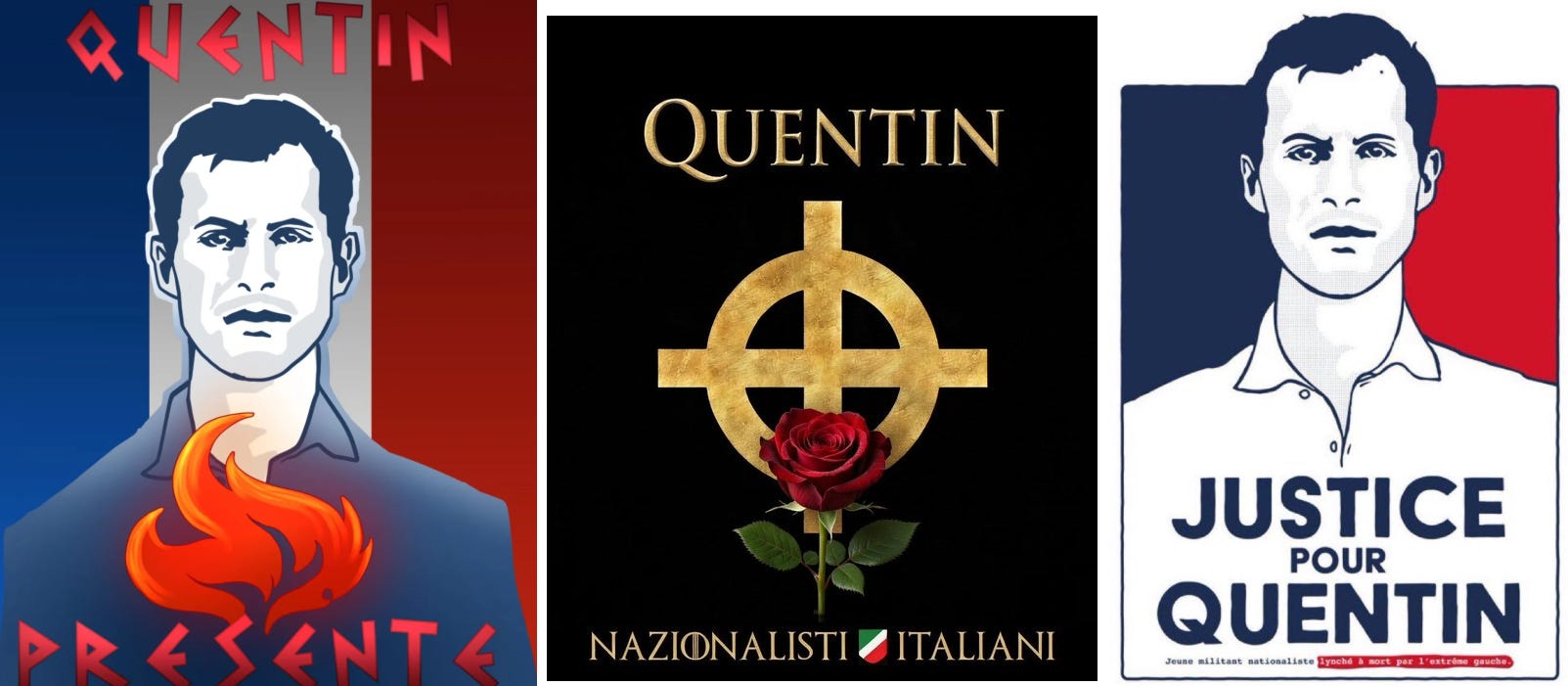
Quentin Deranque was quickly embraced as a kind of French Charlie Kirk. Or: as a martyr.
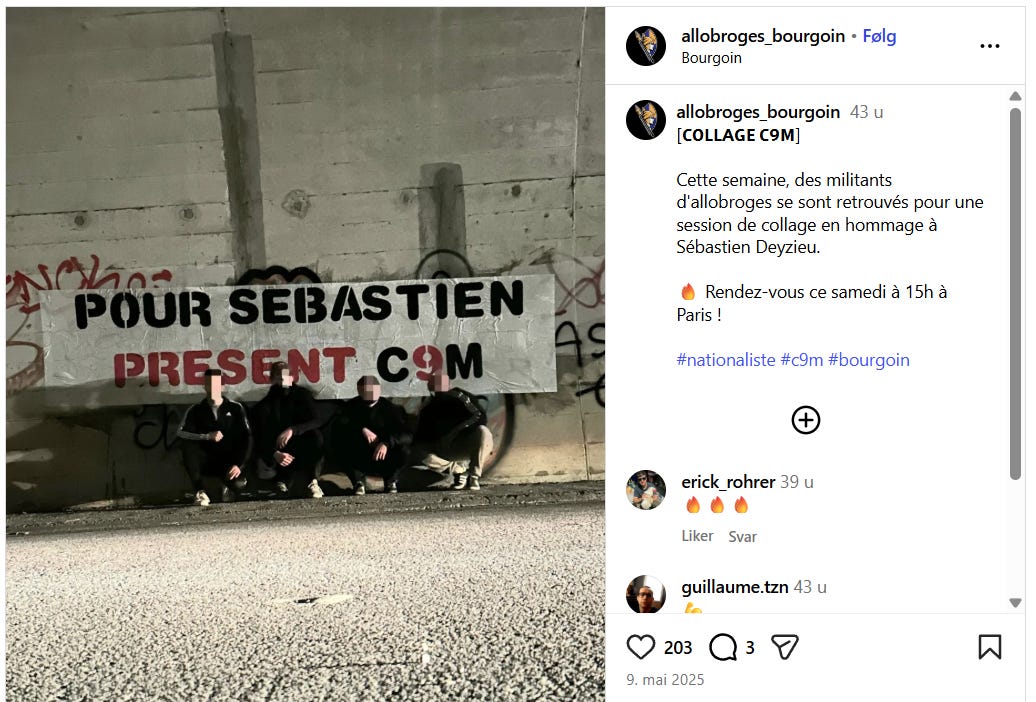
He is not the first such figure for the French far right. The previous one was Sébastien Deyzieu, who died in hospital on the night of May 9, 1994, after falling several stories from a roof while trying to flee from police. Before that he had participated in an illegal demonstration against “fifty years of American imperialism,” organized by two far-right organizations: Groupe Union Défense (GUD)—active under a different name at the time—and Jeunesses nationalistes révolutionnaires (Revolutionary Nationalist Youth).
Deyzieu himself was a member of the ultranationalist group L’Œuvre française.
Shortly after his death, the so-called 9 May Committee was established—emerging in part from GUD. Since then they have held annual commemorations in Paris in memory of the young man. A slogan often appears: “Sébastien présent.” Sébastien is present. The wording is imported directly from Italian fascists, who have particularly used it during commemorations of fallen comrades.
According to an article published in Charlie Hebdo, Quentin Deranque attended the most recent of these events in 2025. The online newspaper Mediapart reports the same.
It is worth digging deeper into the outer edges of French politics. Let us begin with Jeune Garde antifasciste.
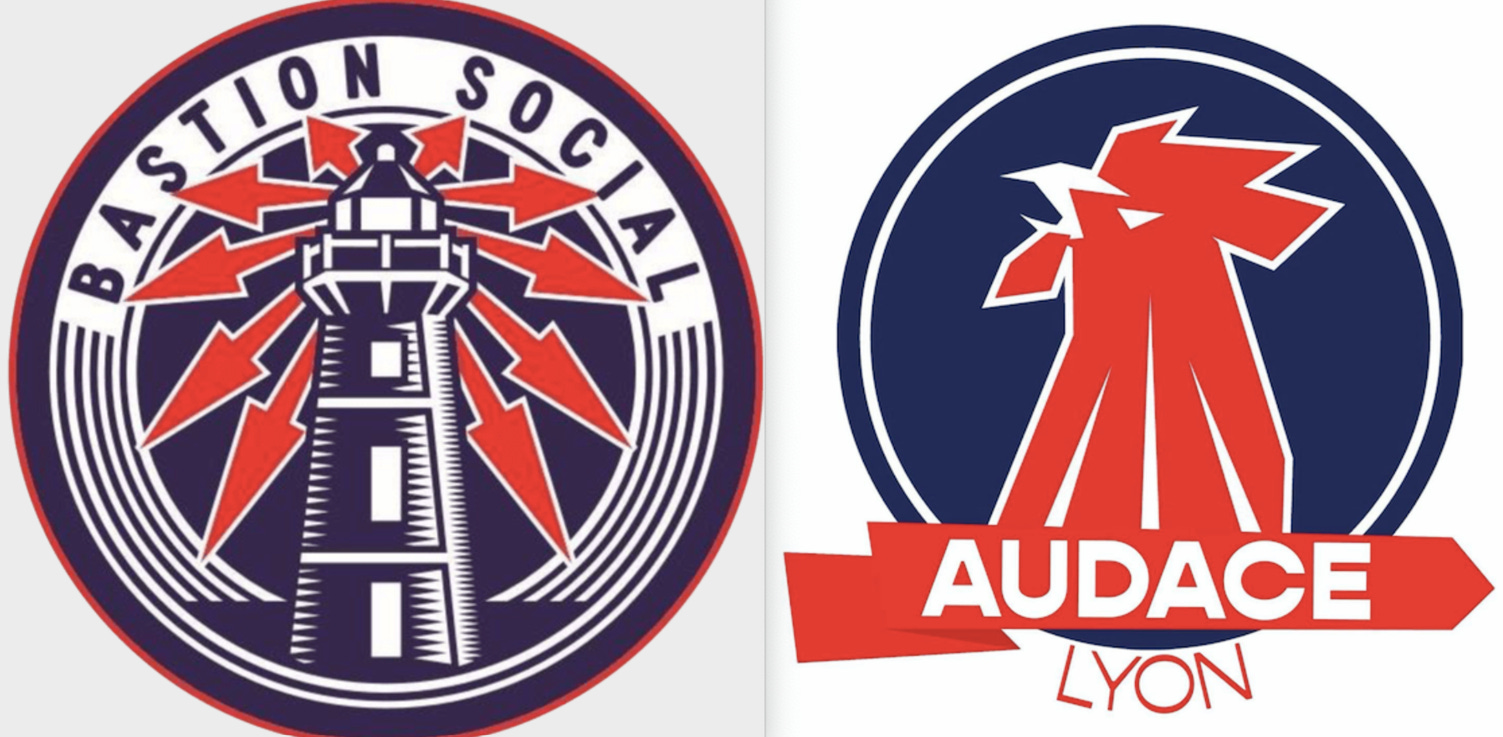
This organization was founded in Lyon in 2018, initially as a kind of reaction to the significant far-right activism in France’s third-largest city, including from a group named Bastion Social, established in 2017 and forcibly dissolved in 2019. Although Bastion Social is often seen as a continuation of the previously mentioned GUD, it drew particular inspiration from the Italian neo-fascists of CasaPound. Like its role models, Bastion Social made a name for itself by occupying buildings and running soup kitchens and other social projects, while at the same time advocating neo-fascist ideology.
During the short time the organization existed, several members were convicted of acts of violence.
Jeune Garde antifasciste chose an old antifascist symbol — three arrows —as its logo, symbolizing the struggle against Nazism, Stalinism, and reactionaries. The last of these is not insignificant, as political scientist Jean-Yves Camus notes in an article in Le Point: from Jeune Garde’s far-left standpoint, this is a broad category. The struggle against fascism is also broad. In the group’s self-presentation from 2018 it states, among other things:
To assert an antifascism based on class struggle […] means understanding that victory over fascism is not possible within capitalist society. Only by overthrowing capitalist society can [fascism] finally be defeated.
Antifascism is not built on a foundation of abstract values, but on a materialist critique of society. We view fascism as an extension of the capitalist system, as its most reactionary and authoritarian form.
It further states that “part of the ruling classes […] claim to fight fascism,” and that these political organizations may well recognize the authoritarian danger represented by fascism but nevertheless “stand far from the interests of the popular classes” and therefore do not constitute a “viable solution.”
In short: Jeune Garde was a reaction to the far right. But it was a reaction firmly rooted in the far left. At the same time, the group criticized “autonomous antifascists,” who according to Jeune Garde had created an antifascist subculture — “often referred to as antifa.”
According to Jeune Garde, this had “helped make the antifascist political struggle less popular.”
As a result, they chose a more open public profile, including in the media. The group soon spread to other French cities.
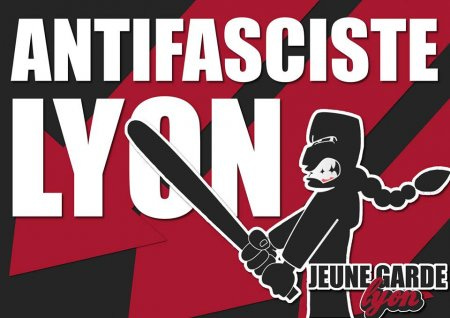
What Jeune Garde nevertheless shared with some so-called Antifa groups —groups which in this context should not be confused with the bogeyman version of Antifa painted by parts of the American right — was that they did not hesitate to use violence, even if it was officially presented as little more than self-defense.
There are plenty of examples of that concept being interpreted very broadly. One occurred in May 2024, when a group of Jeune Garde activists in Paris attacked a Jewish teenager they believed to be affiliated with the Jewish Defense League, a group that had earlier attempted to prevent an event with Rima Hassan.
The teenager was beaten and forced to shout “long live Palestine.” He was also filmed, and an audio recording was posted on Instagram.
Incidents like this eventually led to the French authorities’ dissolution of Jeune Garde in the summer of 2025.
The previously mentioned Raphaël Arnault — one of the organization’s founders and now an LFI parliamentarian — has himself been convicted of violence following an incident connected to an identitarian demonstration in Lyon on April 24, 2021. After the demonstration, a group of six people —including Arnault — attacked a young man. They asked if he had participated in the demonstration, pushed him against a wall, and threw him to the ground after he refused to unlock his phone so they could check whether he had far-right affiliations.
Quentin Deranque’s death did not occur after a straightforward assault but after a mass brawl. A video recorded by an office worker in the neighborhood shows two groups — khaki-clad far-left activists and black-clad far-right activists — clashing. One of the black-clad activists uses a crutch as a weapon. Smoke bombs are thrown, and punches and kicks are exchanged.
It should be emphasized: no evidence has been presented that Deranque actively participated in the fight. Little suggests that he was much of a brawler. Both his family and members of the traditionalist Catholic congregation he had joined have emphasized that he was not violent, and he reportedly had no criminal record.
At the same time, it has emerged that the identitarian women’s group Collectif Némesis had on previous occasions participated in planning ambush attacks targeting the far left. The newspaper L’Humanité reports:
The exchange begins with a text message from the leader of Némésis […]: “We have an activist who studies at Ucly Carnot. She told her friends we are planning a big action tonight, same time and place. Her friends passed it on to another friend, a real anarchist.” So everyone is informed, she warns.
But don’t be fooled—this is not really a problem… Not at all: “There are people close to Jeune Garde, or even activists from there, among those who attacked us last time. So it is very likely they have prepared for our arrival and mobilized the left.”
In this highly secret Telegram group—there are only five members—Calixte Guy, the leader of the “national-revolutionary” micro-group Audace Lyon, replies bluntly: “Did they explain to you what I’m planning?” Ornella replies that unfortunately she hasn’t heard.
“Is it such a big deal,” he asks, “if you move your action somewhere else? You can go to Lyon-II or Lyon-III and carry out your action there… We’ll assemble a team on site to go after the leftists.”
Quentin Deranque was also not a “conservative activist,” as he has been described. The young computer science student had instead been active in Audace Lyon, a kind of successor group to the previously mentioned Bastion Social. He had also helped found a small group called Allobroges Bourgoin, named after a Gallic tribe from the Iron Age and the Roman period.
According to Mediapart, he was also highly active online, posting pseudonymously on X. These comments place him squarely within the “national-revolutionary” or neo-fascist landscape, which also includes both Audace Lyon and Allobroges Bourgoin.
After Deranque’s death, Audace Lyon itself issued a sort of communiqué on X. It speaks volumes:
Salvation from the Islamo-leftist militias will not come from the parliamentary and Zionist right, from those vultures eager for political gain, or from their legislative proposals that will ultimately be used against us, but from the concrete organization of our own self-defense on the ground. It is up to us—and us alone—to ensure that our comrade did not die in vain. Comrade Quentin? Present!
Deranque’s death also has another aftermath beyond parliamentary politics —another consequence beyond the settling of scores with LFI and its leader Jean-Luc Mélenchon.
On Saturday, February 21, a memorial march took place in Lyon. Several thousand people participated. Among them were many activists from the far right. There was a significant police presence, and the demonstration passed peacefully. Participants had been instructed to show restraint, not to use any flags other than the French one, and not to cover their faces. But as Le Monde writes:
At the back of the march, you could sense that some impulsiveness was running up against the exercise of restraint. Discipline was beginning to waver. When groups started chanting "antifa [are] terrorists," arms waved from within the ranks where the organizers stood, ordering everyone to lower their voices. Still, there were noticeably more masked faces, more people wearing armored gloves. The slogans, too, began to change. "White! White! Wake up!" someone shouted. "This is our home, this is our home!"
Videos also appeared online showing participants giving the Nazi salute. And as the march drew to a close, not only was the old counter-revolutionary song La Ligue Noire sung — a song dating back to when the inhabitants of Lyon rebelled against the Jacobin dictatorship in 1793.
Some also began singing Les Lansquenets, an old military song popular among the national-revolutionary French far right.
Notes on the Antiliberal is written by Norwegian journalist Øyvind Strømmen. It will include articles on the radical right, extremism, conspiracy theories and other challenges to liberal democracy. This article from March 2026 is available in the original Norwegian on oyvindstrommen.substack.com.